Who asks for proof of address, and how recent it must be
Your address is first of all where your post arrives: depending on the bank, your card comes by post, and several authorities will write to you there. Proof of address (justificatif de domicile) shows you really live there. Each organisation sets its own list and the maximum age of the document.
- Préfecture, for a residence permit (carte de séjour): proof less than 6 months old. For tenants, the official list includes electricity, gas, water, landline or internet bills, and rent receipts (quittance de loyer).
- Bank, to open an account: the official list for the droit au compte (the right to a bank account) takes documents less than 3 months old, and banks often ask for the same.
Have a complete file of recent documents ready before the first appointment. A rejected document often means booking a second one.
Staying with someone: the attestation d’hébergement
This is the most common solution when you arrive. The person you’re staying with (a relative, a friend or your host family) signs a statement saying you live with them: that’s the attestation d’hébergement. It’s written on plain paper, and service-public offers a free template: you fill it in online, download it as a PDF, then print and sign it.
The attestation, dated and signed
It gives your host’s name and address, your name, and states that you live with them. For a residence permit, the préfecture wants it dated and signed by your host.
A copy of their ID
Their identity card or residence permit. A photocopy is enough.
Proof of address in their name
A copy of their lease, a property deed, or an electricity, gas, water, internet or landline bill. For a residence permit, the préfecture asks for it if the address on their ID is out of date: bring it anyway, as the bank asks for it too.
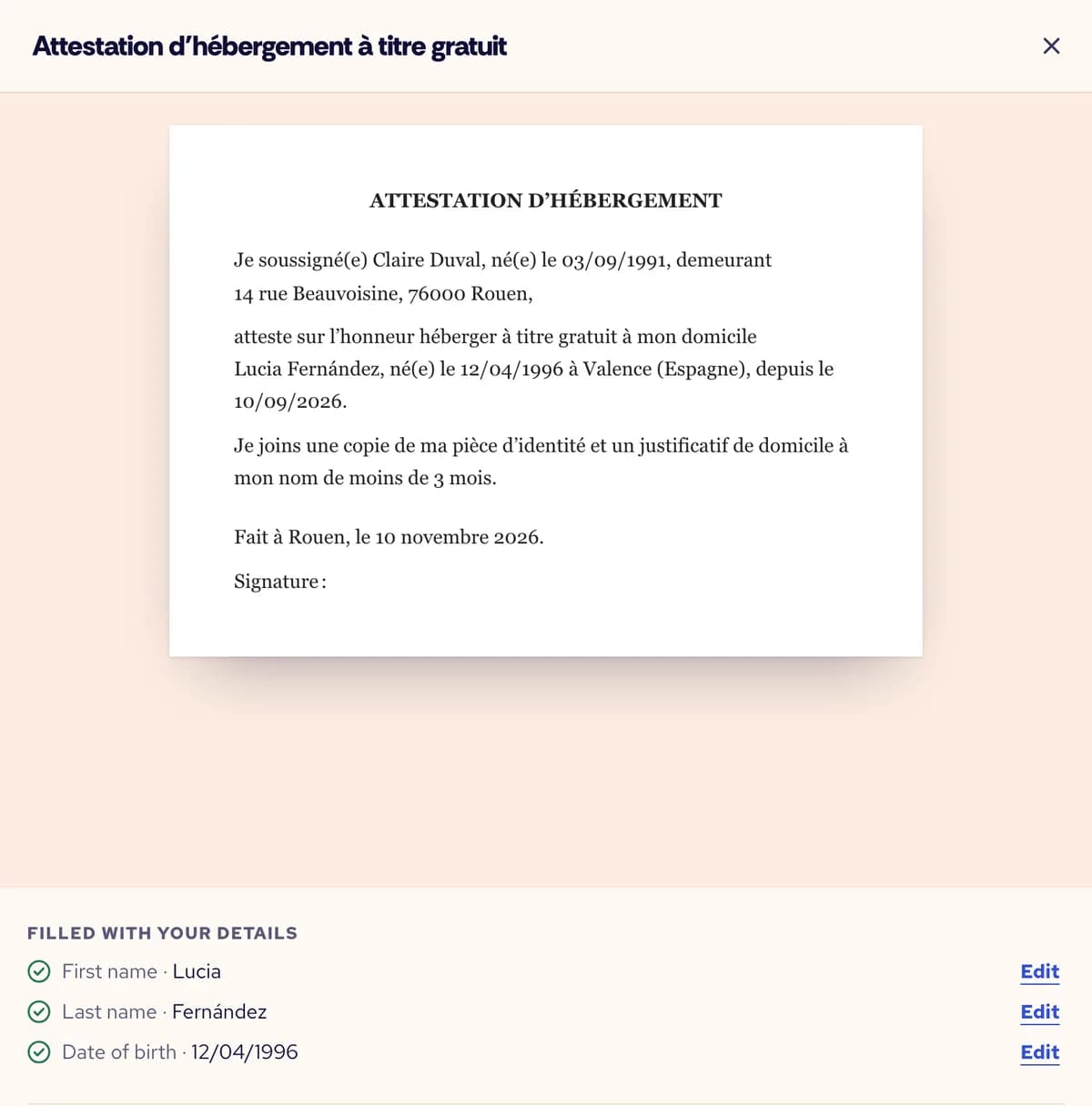
A false attestation commits both the person who signs it and the person who uses it: Article 441-7 of the French Criminal Code provides for one year in prison and a €15,000 fine, and up to three years and €45,000 when it’s used to obtain a residence permit.
In a hotel: the hotel’s attestation
If you’re staying in a hotel, ask the manager for an attestation d’hébergement and keep last month’s bill. That’s the list service-public gives for a residence permit application. Ask for it as soon as you arrive, before you need it.
No fixed address: domiciliation at the CCAS
If you move around a lot, or you’re staying with someone temporarily, you can apply for domiciliation (also called élection de domicile). It’s a free service: an organisation gives you an address where your post is received, and a certificate that counts as proof of address.
Find the right office
It’s the CCAS (the town’s social services centre), a CIAS or an association approved by the préfet. In small towns with no CCAS, it’s sometimes the town hall itself. The town hall will tell you where to go.
Show your link with the town
You must be staying there when you apply, work there, receive social or employment support there, have family there, or have a child at school there.
Fill in the form and attend the interview
You apply on the official form ‘Demande et décision d’élection de domicile’. A compulsory interview explains your rights and obligations.
Get the decision
It comes in writing within 2 months. If accepted, you receive an attestation d’élection de domicile, valid for one year and renewable. Apply for renewal at least 2 months before it ends.
If you’re not a citizen of the European Union, the European Economic Area or Switzerland, you need a residence permit to get this domiciliation. Without one, it’s only possible for a few procedures, such as state medical aid (AME). Asylum seekers have their own system.
Your name on the letterbox
La Poste lists a missing name on the letterbox, doorbell or intercom among the reasons post goes back to the sender. A bank card returned to the bank means a new order and lost time.
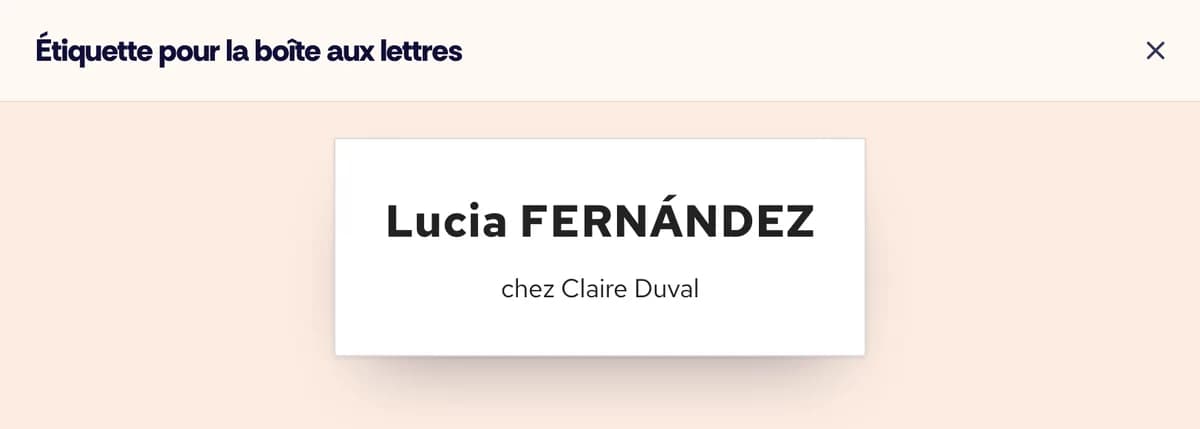
If you’re staying with someone, add your name followed by ‘chez’ and your host’s name (chez means ‘care of’), and write your address exactly that way on every form. The postman then knows which box to use.
Mistakes that cost you an appointment
- Bringing the attestation alone, without your host’s ID and proof of address.
- Giving the préfecture a mobile phone bill: for a residence permit, the official list says landline or internet.
- Bringing an outdated document: check the date before every appointment.
- Forgetting to put your name on the letterbox, then waiting for a bank card that never comes.
FAQ
What is an attestation d’hébergement?
A dated, signed statement in which the person you live with confirms you live with them. It comes with a copy of their ID and proof of address in their name. It’s written on plain paper, and service-public offers a free template.
How long is an attestation d’hébergement valid?
It depends on who receives it. For a residence permit, proof of address must be less than 6 months old. For the right to a bank account, the official list takes documents less than 3 months old. Have it redone when it gets old.
My host rents their home: can they write me an attestation?
Yes. Their proof of address can be a copy of their lease or an electricity, gas, water or internet bill in their name.
Does domiciliation at the CCAS cost anything?
No, it’s a free service. It’s granted for one year, renewable, as long as you have a link with the town and get in touch at least every 3 months.
Attestation d’hébergement or attestation d’accueil: which one do I need?
The attestation d’hébergement, for everything you do to settle in. The attestation d’accueil is for inviting a non-European visitor for under 3 months: it’s requested at the town hall and costs €30.
Official sources
See all 9 sourcesService-public · Ministry of Solidarity · Conseil constitutionnel · Légifrance · La Poste
Service-public · service-public.gouv.fr
Ministry of Solidarity · solidarites.gouv.fr
Conseil constitutionnel · conseil-constitutionnel.fr
Légifrance · legifrance.gouv.fr
La Poste · laposte.fr
General information, checked on the date shown. Rules can change, and the official source always has the final word.