Who can open an account in France
Your nationality doesn’t come into it: as a foreign national, you can open an account in France if you live here legally. To do it on your own, you need to be an adult or an emancipated minor.
- You’re a citizen of the EU, the EEA or Switzerland: you don’t need a titre de séjour (residence permit) to live in France, and your ID card or passport covers the identity side.
- You’re from outside the EU: the bank will want to see your passport and proof that you’re here legally, usually your visa long séjour (long-stay visa) or your titre de séjour. The details vary from bank to bank.
- You still live in another EU country: some banks open accounts for non-residents, on their own terms, and the droit au compte (the legal right to a bank account) also applies to you, for personal use.
A bank can refuse to open an account for you, but it then has to tell you that you can take the matter to the Banque de France. That refusal is what gives you access to the droit au compte, explained further down.
The documents the bank will ask for
The basics come down to two documents: valid official photo ID and a justificatif de domicile (proof of address). Banks can ask for more, and these are the usual ones.
- ID: national identity card, passport, EU residence card or another titre de séjour.
- Address: a rent receipt (quittance de loyer), a water, electricity, internet or phone bill, a home insurance certificate, or your latest tax notice (avis d’imposition). Aim for something less than 3 months old: that’s the rule for the droit au compte, and banks often ask for the same.
- Your situation: work contract, written job offer (promesse d’embauche), enrolment certificate (certificat de scolarité), payslips. As part of its anti-money-laundering checks, the bank can also ask about your income and where your money comes from.
- Tax residence: you’ll fill in a self-certification stating your country of tax residence and, if that’s still your home country, your tax number there. Without it, the bank has to refuse to open the account.
- First deposit: most banks ask for one, and the amount varies.
Neobank or high-street bank: the practical differences
Most neobanks are licensed as payment institutions, a different status from a bank (a credit institution). As a result, some offer no chequebook, no savings account and no overdraft.
Neobank
- You open it in the app, with your ID checked remotely
- Some accept a foreign address to start with
- The IBAN doesn’t always start with FR, and if it’s from the EU it can’t be refused
- Paying in cash is almost impossible, or comes with a fee
- Your money is protected by ring-fencing or insurance; the deposit guarantee scheme doesn’t cover it directly
- No dedicated adviser: help comes through the app
High-street bank
- An adviser at a branch, by appointment
- More documents to provide
- French IBAN, cash over the counter
- Deposits guaranteed up to €100,000 per customer per bank
- Account fees worth comparing
- Handy later if you need a loan
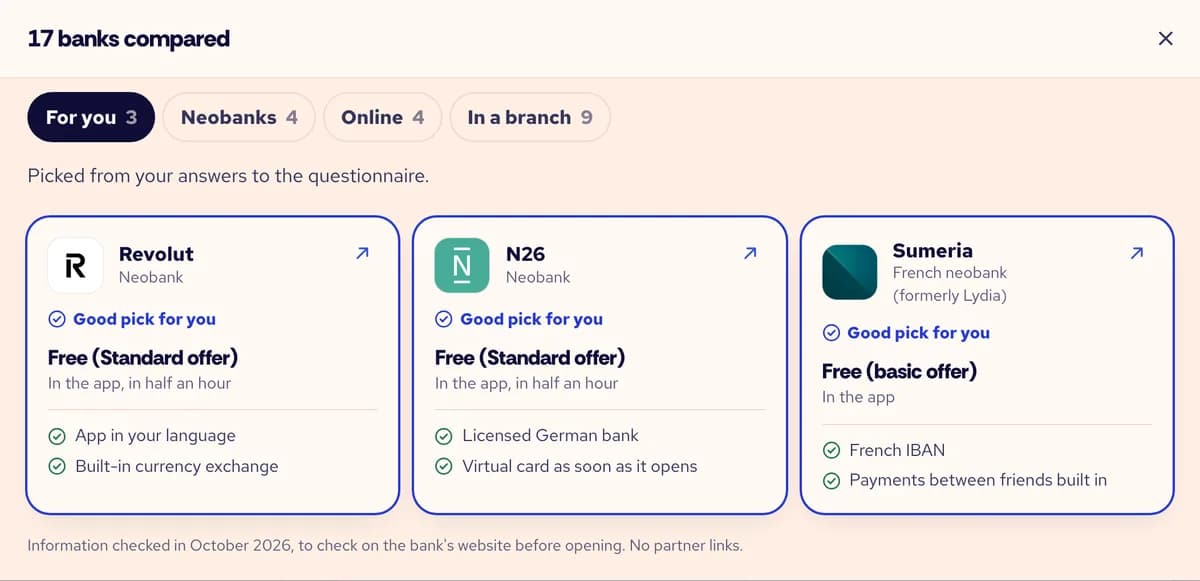
Online banks, the ones with no branches at all, set more conditions: living in France, sometimes a minimum income or a RIB from a traditional bank. For a first account when you arrive, they’re rarely the easiest option.
You don’t have to choose once and for all. A neobank can give you an IBAN in your first few days, and you can open a high-street account later, once your address is stable. Before you trust an app with your money, check the REGAFI register run by the ACPR (the French banking supervisor) to make sure it’s authorised to operate in France. A firm licensed in another European Economic Area country can operate here, and its IBAN sometimes carries that country’s code.
Breaking the address, account, housing loop
The landlord wants a RIB, the bank wants proof of address, and proof of address means having somewhere to live. You get out of the circle on the address side, with a temporary address, or on the account side, with your EU IBAN if you have one.
Find a temporary address
If a friend, a relative or your host family is putting you up, their attestation d’hébergement, with their ID and proof of address, will do. Put your name on the letterbox: depending on the bank, your card and PIN arrive by post.
Failing that, ask for a domiciliation
If no one can host you, a CCAS or CIAS (local social services) or an organisation approved by the préfet can give you an official postal address (domiciliation) when you have no stable home, including if you’re only staying with someone temporarily. You need a link with the town, such as living or working there, plus an interview, and the decision can take up to 2 months. The attestation d’élection de domicile you then receive is valid for a year and accepted as proof of address for opening an account.
Open a first account with what you have
With a complete attestation, try a high-street bank. If all you have is a foreign address, look at the neobanks that accept one to start with, and update your address as soon as you move in.
Or put your EU account to work
A euro account in another EU country can receive your salary and pay your direct debits straight away, so you don’t have to wait for the French one.
Complete your rental application
With a RIB and an address, even a temporary one, your rental dossier finally holds together. Internet or landline bills in your name will then work as your proof of address.
Keeping your EU account and getting your IBAN accepted
If your account back home is in the EU, don’t close it when you leave. For euro transfers and direct debits, the EU SEPA Regulation (No 260/2012, Article 9) bans refusing an IBAN because it comes from another EU country, so your employer can pay your first salary into your account back home.
The Banque de France adds that a company collecting payments from you can’t refuse an IBAN because it was issued by a payment or e-money institution instead of a bank, either. Any discrimination based on where your account is held can be penalised.
An account outside the EU, or in a currency other than the euro, doesn’t get this protection, and you’ll soon need an account in France. When you file your tax return in France, you also have to declare your foreign accounts every year (box 8UU, then form 3916). Forgetting can cost you a €1,500 fine per account, or €10,000 if the country has no agreement with France on fighting tax fraud.
When a bank says no: the droit au compte step by step
The droit au compte covers anyone who lives in France, whatever their nationality, and doesn’t already have a deposit account (compte de dépôt) there, as well as foreign nationals legally resident in another EU country. Having a livret A (a regulated savings account) or a payment account, the kind most neobanks offer, doesn’t rule you out.
Get proof of the refusal
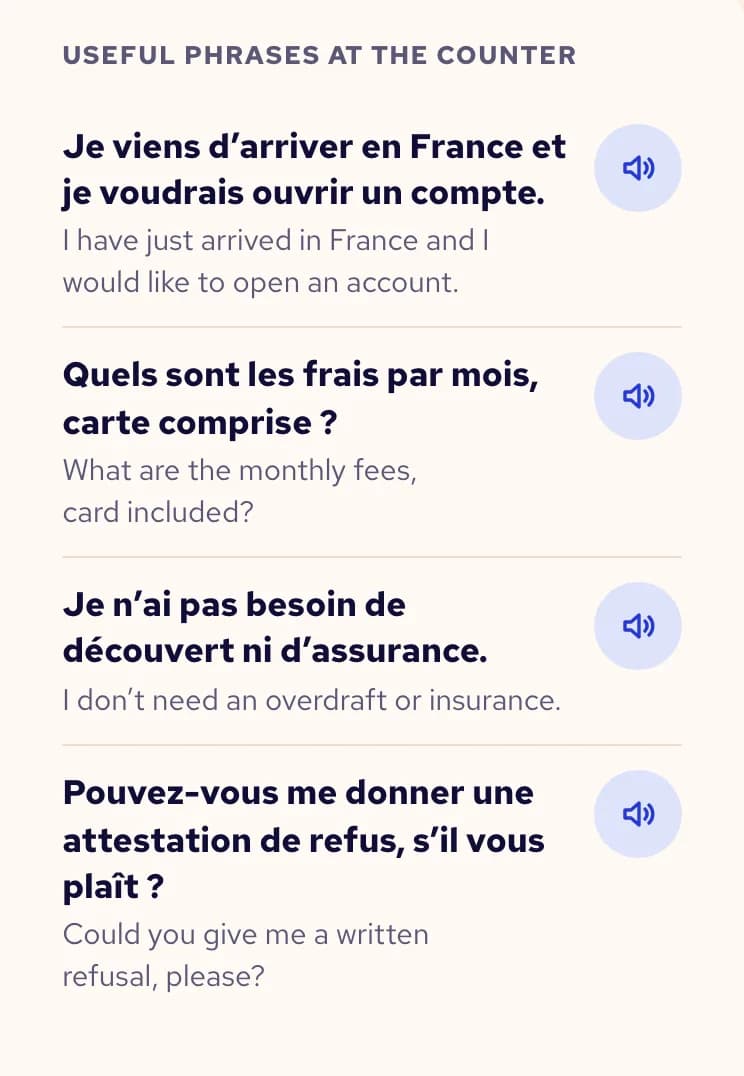
The bank that turns you down must give you an attestation de refus (refusal letter), free and without delay, so ask for it there and then. If you hear nothing within 15 days, their silence counts as a refusal, and your proof of application is what you’ll use instead (an acknowledgement of receipt, or proof you handed it in). That’s why you should apply in writing.
Put the file together
The signed form, a sworn statement (déclaration sur l’honneur) that you don’t have a deposit account, valid ID, proof of address less than 3 months old and the attestation de refus (or proof of a request made more than 15 days ago).
Send the application
Online on the Banque de France website, at the counter of one of its branches (sometimes by appointment) or by post. The bank that refused you can also send the file for you if you ask, and so can a social worker (CCAS, CAF, conseil départemental) or some charities.
Wait for a bank to be designated
The Banque de France designates a bank within 24 hours (one working day, according to service-public) of receiving your file. The designation is valid for 6 months: get in touch with the bank before then, or it can refuse you.
Open the account
Within 3 working days, the designated bank sends you the list of documents it needs and the details of your branch. Once you’ve provided everything, it has 3 working days to open the account.
This account comes with basic banking services free of charge, including:
- a payment card with systematic authorisation (every payment is checked against your balance), which works online and for cash withdrawals in the EU
- SEPA transfers and direct debits, instant transfers included
- cash deposits and withdrawals at the counter
- two banker’s drafts (chèques de banque) a month, or equivalent means of payment
Fees for irregular payments (commissions d’intervention) are capped at €4 per transaction and €20 a month. The designated bank can only refuse on grounds set out in the regulations, such as false documents or an account already open in your name. If it refuses for any other reason, contact the Banque de France.
The most common traps
- Proof of address more than 3 months old. Check the date before your appointment, so you don’t have to go back for that alone.
- Leaving with a verbal no. Without a written attestation or proof of your request, the droit au compte can’t get started.
- Relying on a single neobank when part of your income comes in cash (tips, odd jobs).
- Signing without reading the fee schedule: card fees and account charges vary from one bank to another.
- Installing a ‘bank’ app you spotted on social media without checking on REGAFI that it’s authorised.
How long to allow
The law only sets deadlines for the droit au compte and for domiciliation. Everything else depends on the bank.
- Neobank: quick to open, as long as the remote ID check takes, then the card is posted to you.
- High-street bank: however long it takes to get an appointment, then the card and PIN are sent out.
- Domiciliation: a written decision within 2 months.
- Droit au compte: 15 days of silence count as a refusal, then a bank is designated within 24 hours and the account is opened within 3 working days of a complete file.
With a euro account in the EU, you have some breathing room: you get paid into it while everything else falls into place. Without a usable account, start on the bank as soon as you arrive, at the same time as you look for a temporary address.
FAQ
Can you open a bank account in France without an address?
You need proof of address, but it can be temporary: an attestation d’hébergement from a friend or relative (with their ID and proof of address), or an attestation d’élection de domicile from a CCAS or an approved organisation. Some neobanks also accept a foreign address.
Can my employer insist on a French RIB?
No, if your account is in euros in another EU country: Article 9 of SEPA Regulation No 260/2012 bans that refusal. If your employer insists, report it to the DGCCRF through SignalConso.
Do I need a titre de séjour to open an account?
Not if you’re a citizen of the EU, the EEA or Switzerland: your ID card or passport is enough. From outside the EU, the bank checks that you’re legally resident in France. For the droit au compte, a valid récépissé (the receipt for a titre de séjour application) counts as ID.
I already have a neobank account. Can I still use the droit au compte?
Yes, if it’s a payment account, which is what most neobanks offer: it doesn’t rule you out, and neither does a livret A. A deposit account already open in France does rule you out, though. Your account agreement says which type you have.
How much does it cost to open an account?
Opening one is free. After that, account fees depend on the bank and are listed in its fee schedule. With the droit au compte, basic banking services are free.
Can I open a bank account in France before I arrive?
Depending on the bank or neobank, it’s sometimes possible with a foreign address. If you’re legally resident in another EU country and a bank turns you down, the droit au compte applies too, for personal use.
Official sources
See all 18 sourcesBanque de France · Service-public · Mes questions d’argent · ABE Info Service · ACPR · BOFiP · SignalConso
Banque de France · banque-france.fr
Service-public · service-public.gouv.fr
Mes questions d’argent · mesquestionsdargent.fr
ABE Info Service · abe-infoservice.fr
ACPR · acpr.banque-france.fr
BOFiP · bofip.impots.gouv.fr
SignalConso · signal.conso.gouv.fr
General information, checked on the date shown. Rules can change, and the official source always has the final word.